
Q698 Roller Conveyor Shot Blasting Machine — 800 mm Opening
The smallest machine in the Q69 range, and the one most fabrication shops start with. An 800 mm opening handles flat bar, angle, channel and plate up to 800 mm wide, on 1,000 mm rollers, with the opening height set between 100 and 1,000 mm to suit the sections each buyer actually runs.
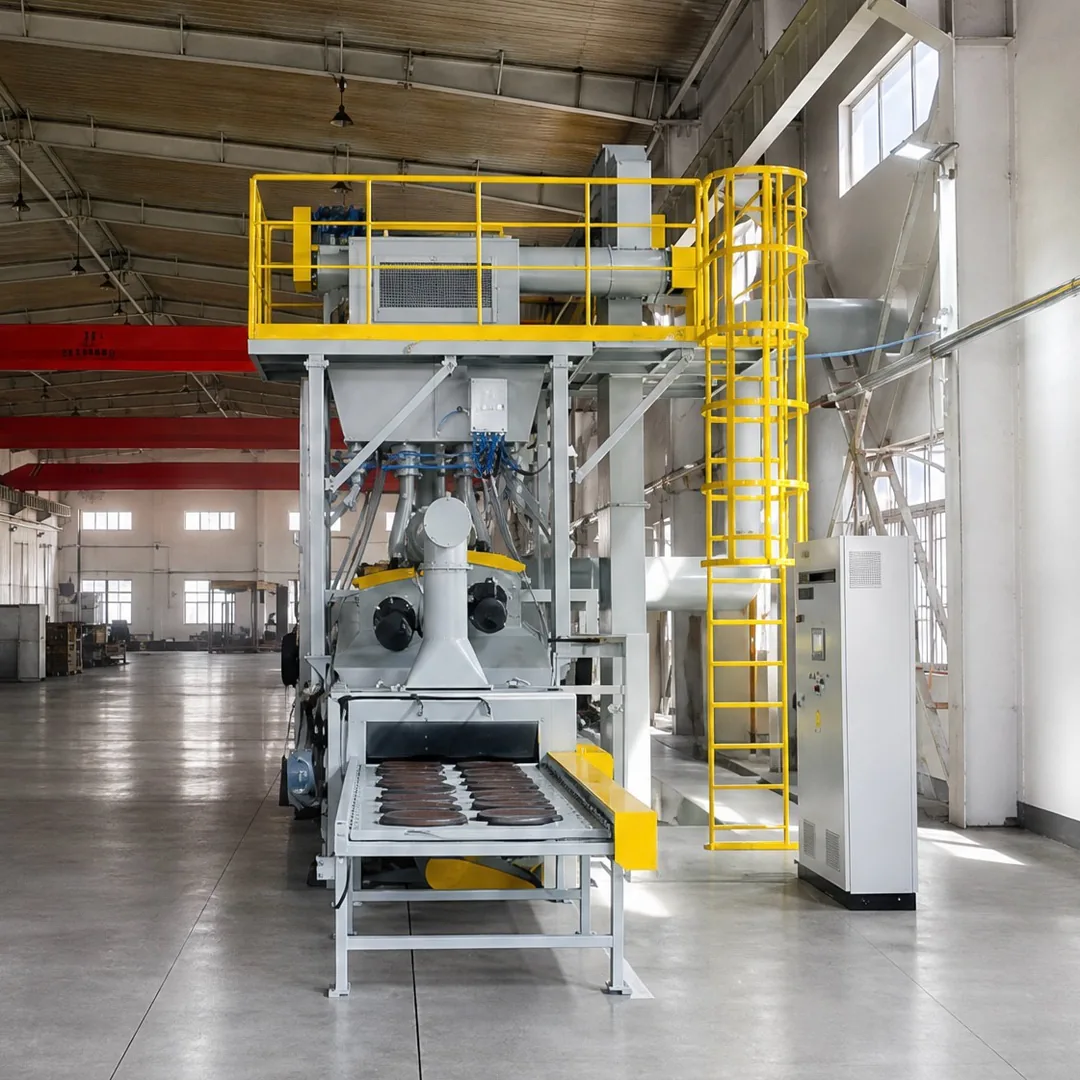
| Opening width × height | 800 mm × 100–1,000 mm (height selectable) |
| Roller conveyor width | 1,000 mm |
| Blast wheels | 4 / 6 / 8 |
| Blast wheel power | 7.5 / 11 / 15 / 18.5 / 22 kW |
| Conveyor speed | 0.5–4 m/min |
| Plate thickness | 3–60 mm |
| First load | 2,000 kg |
| Ventilation volume | 18,000 m³/h |
| Total installed power | 44 kW in the 4 × 11 kW build |
| Depth below floor level | 1,937 mm |
800 mm is the width — the height is a choice
The opening is not a fixed rectangle. Width is set at 800 mm, but the height is specified between 100 and 1,000 mm when the machine is built, because the same width serves two different trades. A steel service centre cutting sheet and flat bar wants a low opening and a tight blast pattern; a fabricator running H-beams and channels wants the full 1,000 mm so the web and both flanges pass the wheels in one go. Choosing the height for your mix of sections is cheaper than buying height you never use — a taller opening needs more extraction volume to keep the same dust level, and more wheel power to cover the face.
Wheel count, wheel power and line speed are one decision
Three numbers on this machine move together, and buyers who treat them separately end up with the wrong combination. The machine can be built with four, six or eight blast wheels, each powered at 7.5, 11, 15, 18.5 or 22 kW, running a conveyor at 0.5–4 m/min. What fixes the combination is the surface standard you have to hit and the tonnage you have to move: a heavier wheel throws more abrasive per minute and reaches the same SA grade at a faster pass, while more wheels spread that coverage across the full width instead of relying on one stream to do the work of three.
In practice the 4 × 11 kW build — 44 kW installed — is the standard starting point for light plate and profiles at moderate throughput. Add wheels before you add wheel power when the problem is coverage at the edges; add power before you add wheels when the problem is heavily scaled plate that needs a longer, harder blast at the same speed.
What 1,000 mm of roller width buys you
The rollers are 1,000 mm wide, wider than the 800 mm cleaning width, so the part sits inside the blast pattern with clearance on both sides rather than hanging over the edge of the conveyor. That margin is what keeps a bent or twisted plate tracking straight through the chamber instead of walking sideways into a wall. Workpieces up to 10–12 m long pass through on the same rollers, which is what makes this a line machine rather than a batch machine — plate goes in from the crane or the shear and comes out the other end ready for priming.
Where the Q698 stops making sense
This is an 800 mm machine, and no amount of wheel power changes that. If your widest regular workpiece is a 1,200 mm plate, or your first load is heavier than 2,000 kg, the Q698 is the wrong starting point — the next steps up the range are the Q6912 at 1,200 mm and the Q6915 at 1,500 mm, with proportionally larger extraction, deeper pits and higher installed power. Sizing the opening to the widest thing you run every week, rather than the widest thing you ran once, is the difference between a machine that earns its floor space and one that idles.
Questions buyers ask about the Q698
Related: the full Q69 roller conveyor range, how wheel coverage is calculated for plate and H-beams, what SA 2.5 and SA 3.0 cost in cycle time.
Send the widest section you run
Width, height, thickness, the standard you have to reach and the tonnage per shift — we will confirm the opening, the wheel count and the speed.
Get a quote