
Why We Don't Publish Shot Blasting Machine Prices — and How Wheel Count Follows Chamber Size
Almost nobody in this industry publishes a price list, and buyers reasonably read that as evasion. The honest explanation is arithmetic: a machine is a chamber, a set of blast wheels, an abrasive circuit, a dust system and an electrical package sized to one customer's parts.
So instead of a price list, here is the variable that actually moves the number — the one most buyers underestimate when they compare quotations from three suppliers and wonder why the spread is so wide.
The chamber decides the wheel count
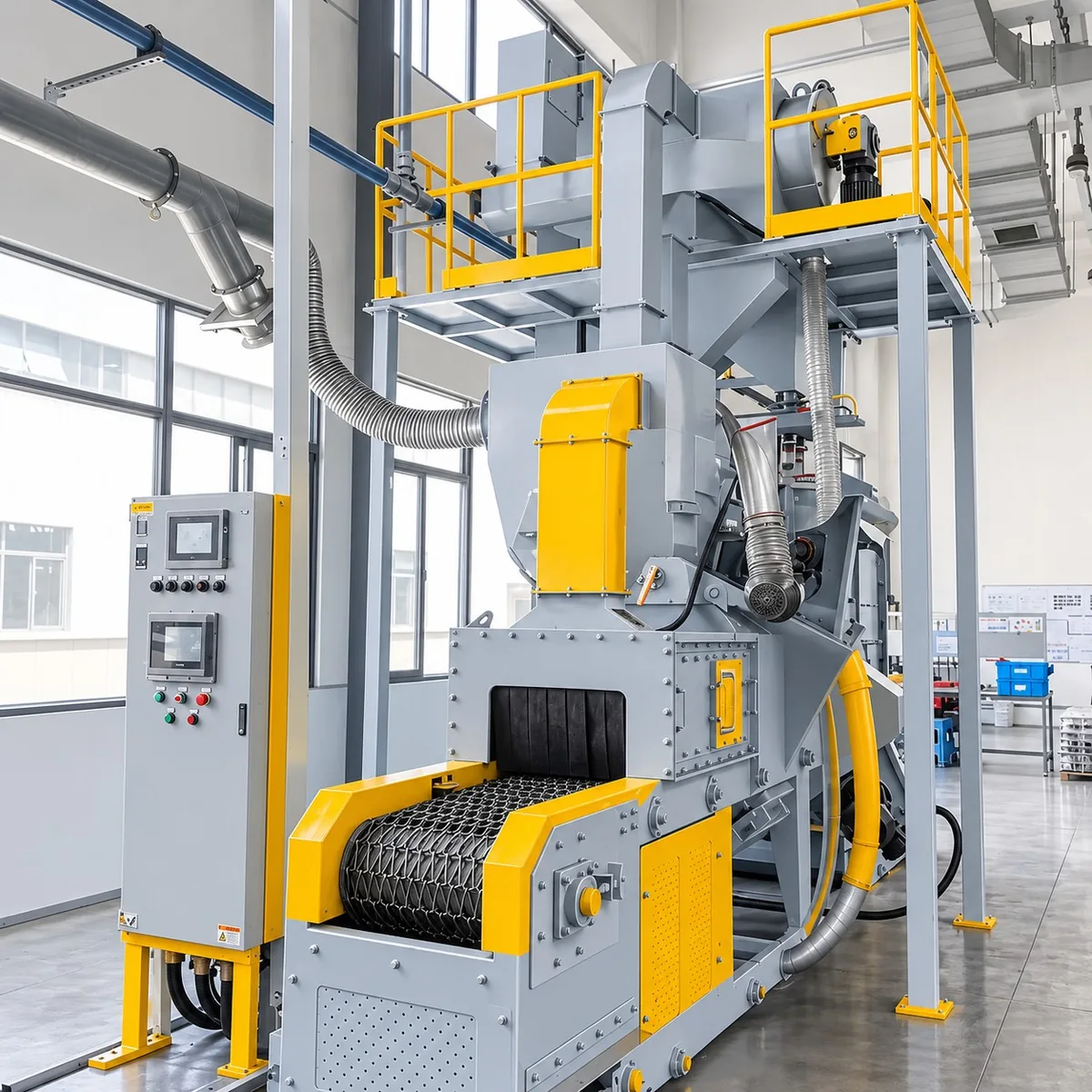
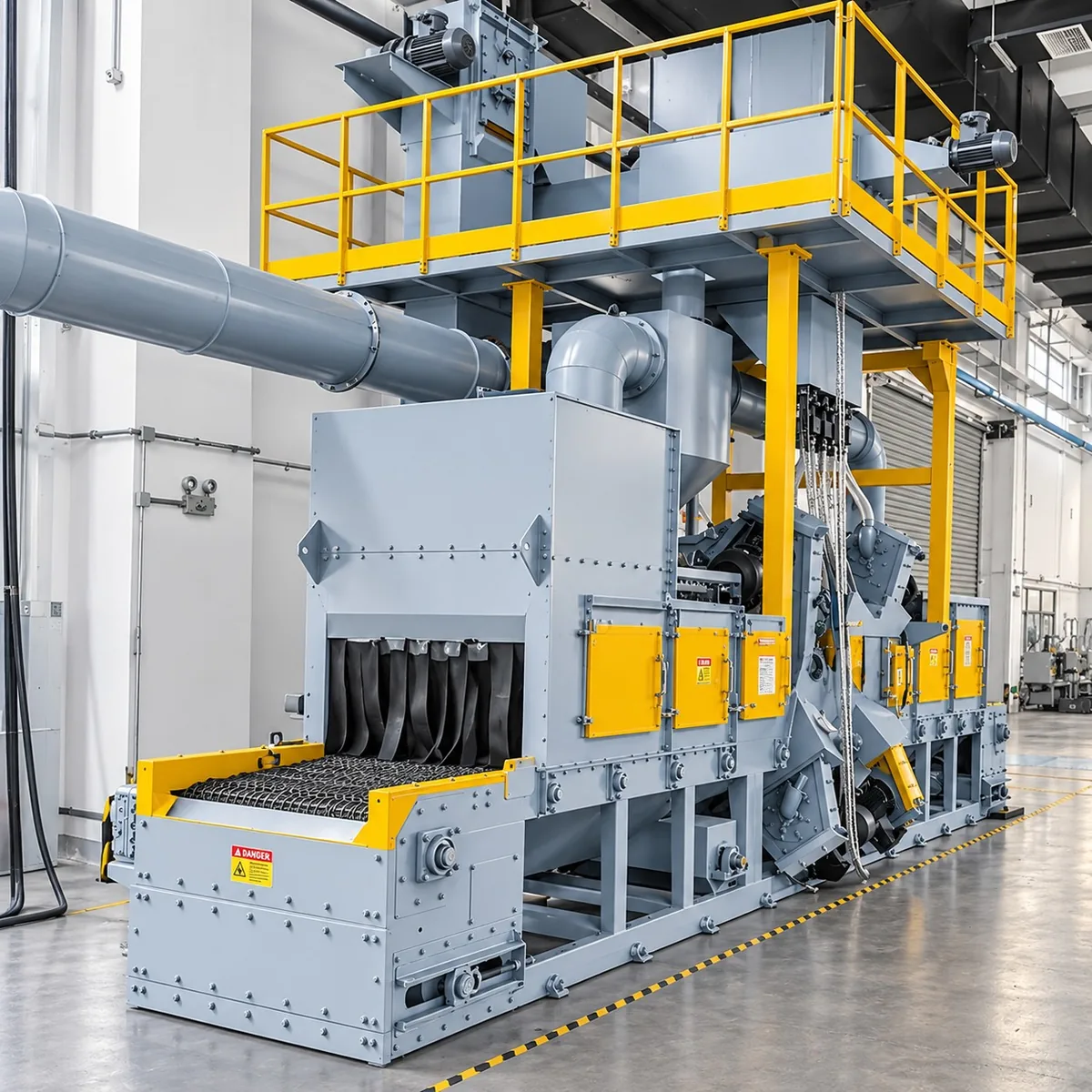
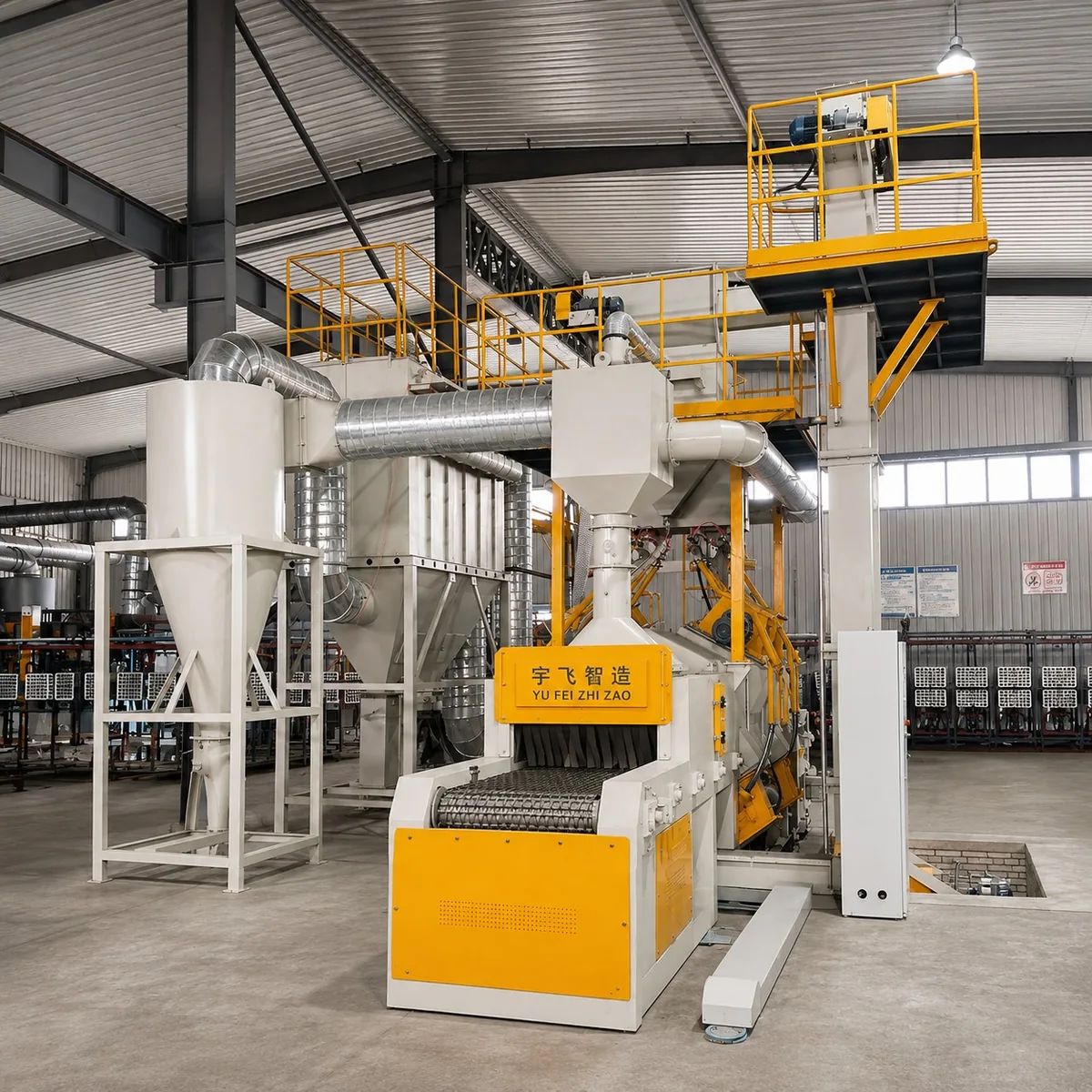
A blast wheel throws a pattern with a fixed footprint. On a narrow chamber, one wheel above the work covers the working width. Widen the chamber and the same wheel leaves a strip at each edge that receives far less abrasive — you see it on the finished part as a lighter band, or a surface profile that fails the SA grade you specified.
The fix is not a bigger wheel. It is another wheel, placed so its pattern overlaps its neighbour's. That is why wheel count tracks working width and steps in pairs rather than one at a time.
Related: which machine type fits your part, the Q326 model page.
| Working width | Blast wheels | Wheel power options |
|---|---|---|
| 600–1,000 mm | 4 | 7.5 / 11 / 15 kW |
| 1,000–1,500 mm | 6 | 7.5 / 11 / 15 kW |
| 1,500–2,500 mm | 8 | 7.5 / 11 / 15 kW |
| 2,500–3,000 mm | evaluated per project | per project |
Three thousand millimetres is our current maximum working width. Beyond 2,500 mm the layout stops following a table and gets drawn for the job.
Width is half the answer; height is the other half
A chamber has two dimensions that matter, and buyers usually only quote one. Width decides how many wheels you need across the work. Height decides where those wheels sit, and whether the face can be covered in one pass at all.
A 1,200 mm wide, 600 mm tall opening is a different problem from a 1,200 mm wide, 2,000 mm tall one, even though the width column reads the same. In the tall chamber the wheels have to be arranged to cover a vertical face, and the part path — belt, hook or roller — determines whether that face passes the blast zone once or twice.
This is why we quote against the opening, not against a model name. Two machines can carry the same wheel count and still be different machines.
Wheel power: three options, and what changes
Every layout above can be fitted with 7.5, 11 or 15 kW wheels. The choice is not a tier you buy into; it is a match to the work.
- Higher wheel power throws more abrasive per minute, and throws it harder.
- That shortens the time a part needs in the blast zone, which matters when the throughput target is high or the scale is heavy.
- It also raises installed power, abrasive circulation load and the wear rate on liners and housings — which is why fitting the largest wheel to a light job is a cost with no return.
We size it against the part: section thickness, surface condition before blasting, the grade you need to reach, and how many parts per shift. A 7.5 kW wheel on a chamber sized for thin sheet is not a compromise. A 15 kW wheel on the same chamber usually is one.
What else moves the number
Wheel count is the visible variable. It is rarely the most expensive one on its own. Adding wheels pulls the whole machine up with it:
- Installed power and electrics. Each wheel carries its own motor and starter. Eight wheels is not two more motors than six — it is different cable sizing, a different control cabinet, a different panel layout.
- Abrasive circulation. More wheels throw more shot per minute, so the bucket elevator, the separator and the hopper have to move and clean more. Undersize this and you get fine dust in the abrasive and uneven wheel wear.
- Dust collection. Blast volume and dust load scale together. Filter area and fan have to follow, or the cabin runs positive and dust escapes at the inlet and outlet seals.
- Wear parts. Chamber liners, belt, guards and housings all grow in area. We split the chamber into zones — rolled manganese in the hot zone where the abrasive actually lands, NM500 elsewhere. That is a cost decision, and one of the few honest places to save money.
- The parts you touch. Belt or roller speed with VFD, loading and unloading, inlet height, whether the machine sits in a pit, and the voltage and frequency of the grid it will run on.
Two machines with the same chamber and the same wheel count can still differ widely, because one is built for a single shift of light sheet and the other for three shifts of 12 mm plate.
Standard sizes, and where custom starts
We keep a standard range of chamber sizes so that common jobs do not pay for engineering. Past those sizes the machine is drawn to the part, and that is where most of our work sits — chambers wider than 1,500 mm, openings tall enough for fabricated frames, infeed and outfeed matched to an existing line.
Custom is not automatically more expensive. A standard chamber that is slightly too wide for your parts costs more than a narrower one built to your envelope. The expensive option is the machine that almost fits.
What we need in order to quote
We quote against parts, not model numbers. Six things get us to a firm number:
- Part drawings or a dimensioned sketch, and the heaviest single piece
- Required throughput — parts per shift, or square metres per hour
- Surface grade — SA 2.5 or SA 3.0, and the coating going on afterwards
- Voltage, phase and frequency at the installation site
- Site constraints — ceiling height, pit or no pit, floor loading, and how the machine gets into the building
- Loading method — manual, hoist, conveyor or robot
Send those and the configuration conversation takes one exchange instead of six.
Questions we get asked
Why not publish a starting price?
Because a starting price is for a machine nobody buys. Every quotation is for a specific width, wheel layout and wear specification. Quoting a smaller machine to win the comparison only moves the disappointment to the installation date.
Can I add wheels later?
Occasionally, on a chamber designed with the space and power reserved. Usually not: the elevator, separator and dust collector were sized for the original blast volume, and the cabinet is not built to take another wheel housing. If you expect to widen your part range later, say so at quotation stage — cheap then, expensive afterwards.
Is a machine with more wheels always better?
No. Wheels hitting the same path repeatedly over-blast the centre and leave the edges unchanged, while you pay for the power and the wear parts. What we size for is coverage: every point on the work passing under enough abrasive, once, at the right angle.
What is standard, then?
The chamber sizes in our standard range, in the wheel counts shown above, with the electrical package and liner specification we build most often. Width, height, wheel power, speed, loading, voltage and liner zones are set per order.
If you have a part drawing and a throughput figure, that is enough to start — see the wire mesh belt machine range for the standard models, or send us the drawing and we will come back with a chamber size, a wheel layout and a number.
Send Your Part Drawing