
Model page
Q376 — the small end of the hook range
A Φ1000 × 1000 mm working envelope, two blast turbines and a 1,500 mm chamber. It is the machine for parts that are too big to tumble and too small to justify a Q3740 — one fabrication at a time, hung on a hook that turns it through the blast stream.
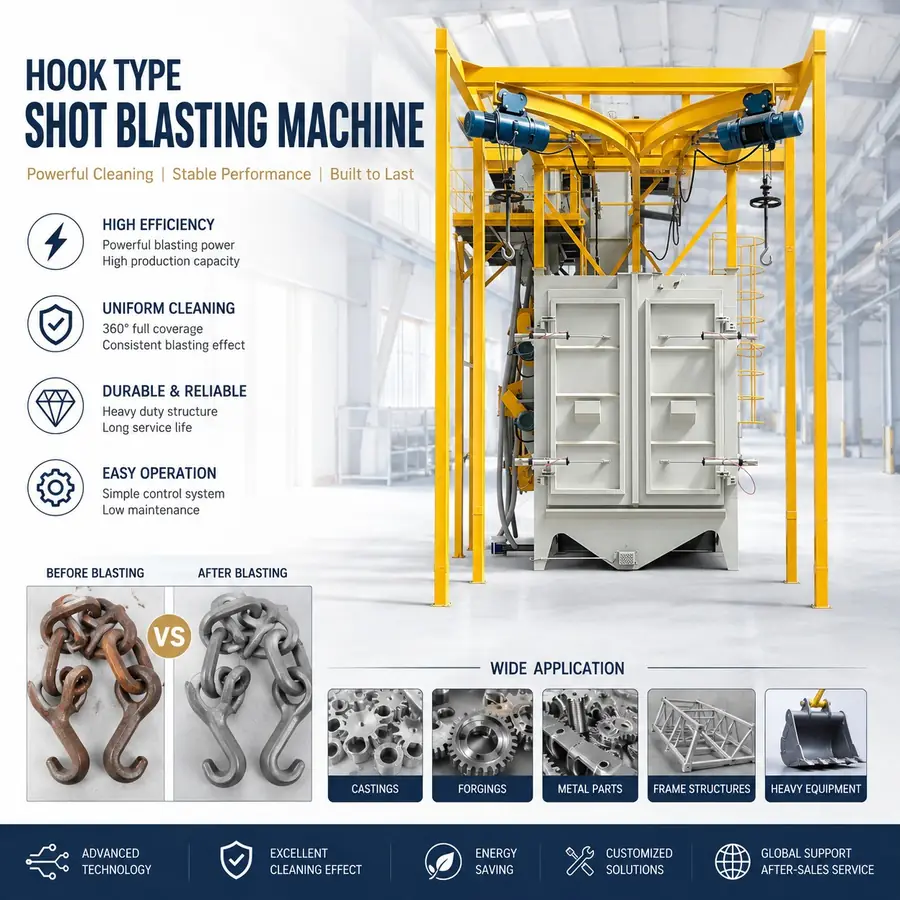
What Φ1000 × 1000 actually allows
The number is a rotating envelope, not a box: the part turns on the hook, so the diagonal is what has to clear the chamber wall, not the face. A 1,000 mm cube is the nominal limit; a 1,000 × 300 × 1,000 mm frame is comfortable, a 1,200 mm long bracket is not — it will hit the wall on the way round.
Two turbines at the top of the chamber cover the part as it rotates. They are not there to blast harder but to reach both faces of a hanging part without a second pass: on a hook machine the part does not tumble, so coverage has to come from the wheels and from the rotation, not from parts falling over each other.
Full specification
Related: the hook type range · which machine type fits your part · how configuration sets the price
| Parameter | Q376 |
|---|---|
| Max product size (Φ × H) | Φ1000 × 1000 mm |
| Blast turbines | 2 |
| Screw conveyor power | 1.5 kW |
| Ventilation volume | 4,000 m³/h |
| Cleaning chamber L | 1,500 mm |
| Cleaning chamber W | 1,500 mm |
| Cleaning chamber H | 1,800 mm |
Designed to standard shipping container dimensions, so it ships as a normal container load rather than as break-bulk cargo.
Where this machine is the right answer
- Fabricated frames, brackets and weldments that must not be tumbled against each other.
- Machined or painted parts where impact damage costs more than the blasting.
- One-off or low-volume work, where loading a batch is slower than hanging one part.
- Mixed sizes in the same week — the hook does not care whether the next job is a casting or a welded assembly.
Where it stops: parts above Φ1000 mm, parts taller than 1,000 mm, and anything needing continuous throughput. For a taller envelope the next step is the Q3740 (Φ1500 × 3200 mm); for parts that can be tumbled, a tumble belt cleans more per hour at the same budget.
A Q376 in production
A Q376 was delivered to TOPRICH in Kenya for structural steel work, specified to reach SA 2.5 before painting. The project is written up with the acceptance readings and the reasons behind the chamber clearance: a Q376 in Kenya.
Delivery, warranty and spare parts
- Built to order — the delivery date is confirmed in the quotation, not promised from stock.
- Warranty 1–2 years depending on the application, written into the quotation.
- Blast wheels, blades and liners ship by air freight, about 7 days to most countries.
- Payment 30% T/T with the order, 70% before shipment.
Questions about the Q376
Will it fit through a standard container door?
Yes. The Q376 is designed to standard container dimensions — that is a design constraint, not an afterthought, and it is why the chamber is 1,500 mm wide rather than larger.
Can I add a third turbine?
The Q376 is a two-wheel layout. If your parts need three, the Q3710 gives you a Φ1500 × 1700 mm envelope with three wheels, which is a different machine rather than an option on this one.
What voltage can it be built for?
380V, 415V, 440V, 460V, 480V, 600V or 220–230V at 50 or 60 Hz. Each unit is wired and run at its destination voltage before it is crated.